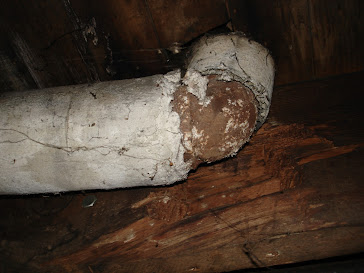
Just about every week I
get asked that question. Home inspectors are fully aware that the “A” word
could create confusion and fear in our clients. Most standards of practice
& code of ethics we follow do not recommend or allow us to note that
Asbestos is present without first testing for it. Of course those of us that
have been doing this for any length of time know what Asbestos looks like and
where it is commonly found. Many people think that Asbestos is no longer in any
products on the market. If you
think asbestos is banned in the U.S., that is not the case. From 1973 to 1978,
the United States Environmental Protection Agency (EPA) did ban everything from
asbestos pipe and block insulation to the use of asbestos in artificial
fireplace embers and wall patching compounds. In 1989, the EPA issued a final
rule under Section 6 of Toxic Substances Control Act (TSCA) banning most
asbestos-containing products. However, just
a few years later, the rule was vacated and remanded by the Fifth Circuit Court
of Appeals. As a result, most of the original ban on the manufacture,
importation, processing, and distribution in commerce for the majority of the
asbestos-containing products originally covered in the 1989 final rule was
overturned. Today, asbestos is still used in dozens of products, and the public
might not be aware of just how close to home these products are. Asbestos is
the only cause of mesothelioma, so it is important to be aware of the products
that still contain this deadly mineral. We know that
Asbestos can be found in insulation of boiler / stem pipes, around forced air
ducts, insulation, siding materials, roofing materials, & inside or around
old fuse boxes. It still is used in the following areas:
Construction
Materials - Many homes built before 1980 already have asbestos
in their flooring, insulation, plaster, and paint. Today, it is still legal to
manufacture, import, process and distribute asbestos-containing construction
materials such as cement corrugated sheet, flat sheet, pipe, and shingle,
non-roof coatings, pipeline wrap, roof coatings, roofing felt, and vinyl tile
floor.
Car Parts - Asbestos can still be found in automatic
transmission components, brake blocks, clutch facings, disk brake pads, drum
brake linings, friction materials, and gaskets.
Fertilizer and
Potting Soil - According
to the Illinois Department of Public Health (IDPH), vermiculite (which may
contain a type of naturally occurring asbestos called tremolite-actinolite) has
been used in some potting soil and fertilizer. The IDPH says the mineral is
used in potting soil for plant growth, and it appears as bright gold or silver
flakes.
Talc - Although talc isn’t made with asbestos
today, Consumer Safety says, “in nature, talc deposits occur
together with asbestos, and mined talc can easily become contaminated with asbestos.”
Some companies have been sued over talc products that have been found to
contain asbestos.
How should a home inspector properly advise their clients
and a link to A Homeowners Guide To
Asbestos & Removal and a Vermiculite removal program that will financially
assist your clients when Asbestos is suspected:
·
When you suspect Asbestos recommend your client have
the material in question tested for hazardous materials including Asbestos. Make sure this recommendation is in your
written report
·
Explain to them that products containing Asbestos
may not pose a risk if it has been properly encapsulated. Refer them to a
professional who can further evaluate and advise them
·
Do not disturb the material. Leave that to the
professionals
·
We do not recommend a home inspector test for
Asbestos unless specifically trained because it would have to be disturbed
which could cause a problem
·
Advise the homeowner if they plan to perform any
construction work in the area where the Asbestos is contained to contact a
professional first to ensure it is safe
·
If the Asbestos is not friable, and in areas where
it will not come into contact with individuals, it may not pose a risk to the
occupants. Recommend further evaluation and testing.
·
Any friable Asbestos should be removed by a trained
abatement company
·
For Vermiculite suspected in insulation contact:
Zonolite Attic Insulation Trust by CLICKING
HERE. They have a program that will financially assist your clients in
removing and re-insulating their attic
·
CLICK
HERE for a Homeowners Guide to Asbestos & Removal you can share with
your clients


No comments:
Post a Comment